Maintenance Expert Reveals 7 Hidden Causes of Coolant Accumulation in the Reservoir Tank
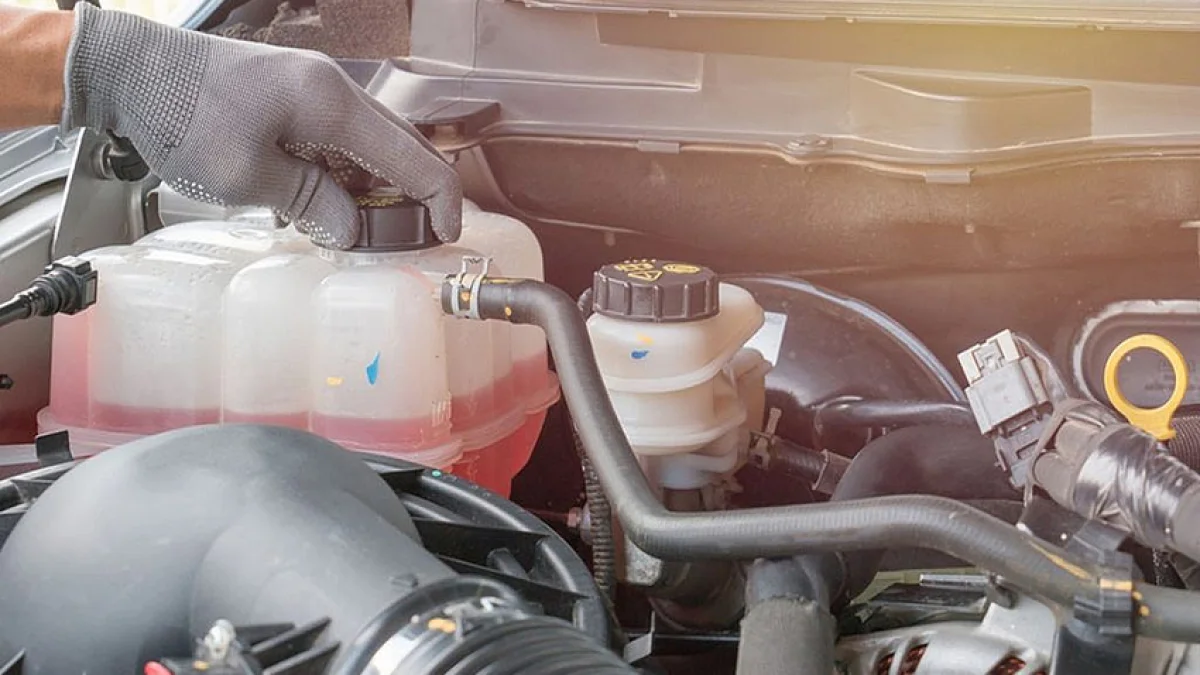
The issue of coolant remaining in the reservoir tank without returning to the radiator is a common problem faced by many car owners. In this context, Waleed Abdo, manager of an automotive maintenance center, revealed seven hidden causes that may lead to this problem, ranging from simple faults that can be easily resolved to more complex issues requiring specialized technical intervention.
Key Technical Causes of Coolant Accumulation
Abdo explained that the most common cause is a faulty radiator cap, which acts as a dual valve allowing coolant to flow to the reservoir when pressure rises, then return it to the radiator when the engine cools. Any defect in the suction valve can cause water to accumulate in the reservoir without returning to its normal place. He also pointed out that a blocked or kinked hose connecting the radiator and coolant reservoir can prevent fluid movement back and forth, and that air pockets in the cooling system after maintenance can disrupt system pressure and affect fluid flow.
Leaks and Additional Malfunctions Affecting the System
The expert confirmed that a leak in the cooling system, whether in the radiator or hoses, allows air to enter the system instead of drawing water from the reservoir during the cooling process, leading to continued reservoir fullness. Among other causes, Abdo mentioned a blown head gasket, where combustion pressure leaks into the cooling passages, forcing water strongly toward the reservoir. This condition is usually accompanied by persistent air bubbles, low coolant levels, engine overheating, or white smoke from the exhaust.
Blockages and Mechanical Failures
Abdo noted that partial blockage inside the radiator due to sediment buildup can increase internal pressure and push additional coolant into the reservoir. There is also the possibility of a malfunction in one of the cooling system components, such as the thermostat, cooling fan, or water pump, which may cause the coolant to boil and expand more than normal. He emphasized that diagnosing the problem begins by checking the coolant level in the radiator when the engine is completely cold, ensuring the hose connecting to the reservoir is intact and free from blockages or cracks, and trying to replace the radiator cap with an original and approved one.
Diagnosis and Maintenance Tips
Abdo concluded by stressing that if persistent air bubbles or abnormal engine overheating are observed, the cylinder head and gasket must be inspected immediately, noting that most cases result from a faulty radiator cap or a blocked reservoir hose. Experts recommend performing regular maintenance on the car's cooling system, paying attention to radiator cleanliness, and regularly inspecting hoses and caps to ensure the system operates efficiently and to avoid sudden breakdowns that could lead to engine overheating and damage.
Related News
View All News
Signs of Spark Plug Failure in Your Car Engine — When to Replace Them
Spark plugs are essential engine components, and their failure causes difficulty starting, engine vibration, poor acceleration, and increased fuel consumption. Other signs include an illuminated check engine light and exhaust…

Your Complete Guide to Maintaining Car Tires as Winter Temperatures Drop
As winter approaches and temperatures fall, car tires need extra care to maintain grip and safety. Regular pressure checks, tread depth inspection, crack monitoring, and wheel alignment are essential steps.…
From Paper to Pavement: Inside the Making of a New Car
Developing a new car begins in the design studio with initial sketches that become a 3D digital model and then a full-size clay model. Engineering teams work in parallel to…

Tesla Drops 'Self-Driving' Name in Europe, Calls It 'Driver Assistant'
Tesla has renamed its 'Autopilot' system to 'Tesla Driver Assistant' in Europe after misleading claims. This change follows legal disputes and a retreat from full self-driving promises. In the U.S.,…

Chery Tiggo 9 CSH Survives Brutal Safety Tests: Saltwater Immersion and Underbody Impacts
Chery conducted extreme safety tests on the Tiggo 9 CSH, including a 24-hour saltwater immersion of its high-voltage battery and an underbody scraping test against a solid obstacle. Results showed…