

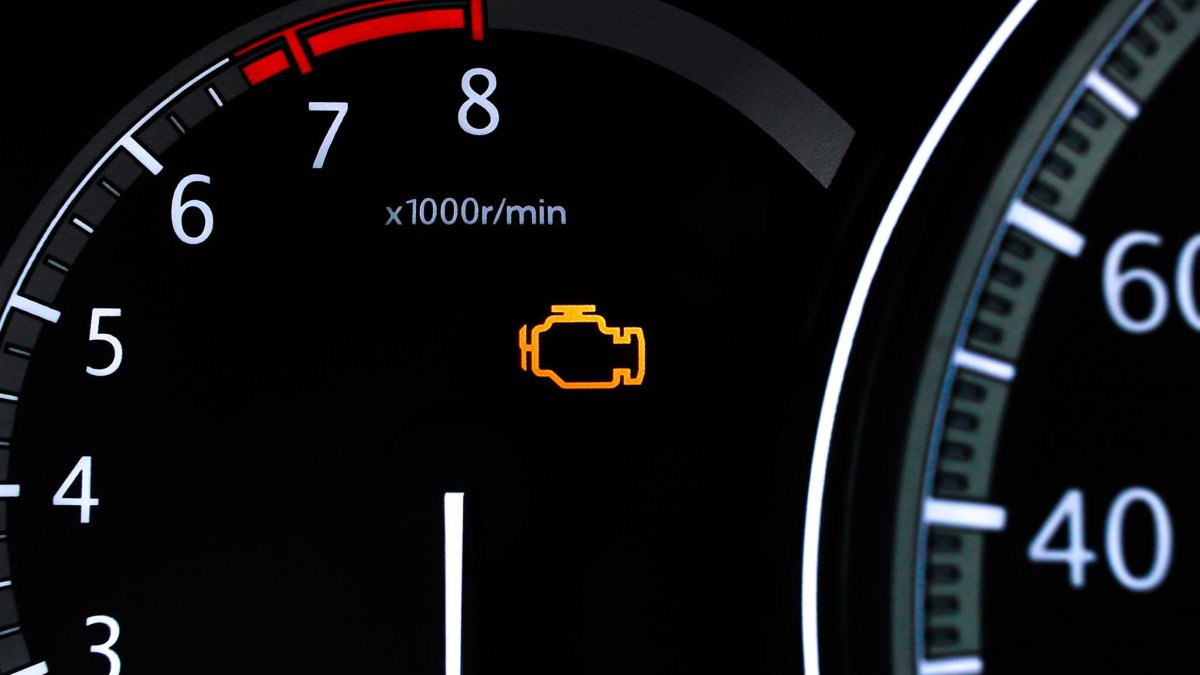
Understanding the Check Engine Light: When Is It Normal and When Is It a Serious Warning?
The Check Engine light is one of the most anxiety-inducing signals for drivers, especially when it suddenly illuminates on the dashboard. However, many are unaware that it lighting up for a few moments during startup is perfectly normal in most modern vehicles.
Automotive experts confirm that the car's computer automatically performs a self-test of the electronic systems and sensors when the engine is started. Therefore, the Check Engine light appears for a few seconds as part of this diagnostic routine to ensure the system is functioning correctly.
When Is the Check Engine Light Normal?
If the Check Engine light turns on when you start the car and then disappears after a few seconds, there is usually no problem. This behavior is entirely normal and indicates that the self-diagnostic system is working properly.
This rule also applies to several other warning lights, such as the ABS, battery, and oil pressure lights, which temporarily illuminate during startup and then turn off.
When Does It Become a Warning Sign?
The issue begins when the light remains on after the engine starts or reappears while driving. This indicates that the system has detected a fault in one of the systems related to the engine, emissions, or electronic sensors.
Sometimes the cause is simple, such as a loose fuel cap or a faulty sensor. At other times, it may point to more significant issues within the engine, fuel system, or ignition system.
Steady vs. Flashing Light
Specialists point out that the behavior of the light itself is crucial for diagnosis. A steady light usually means there is a fault that requires inspection but is not an immediate emergency.
However, if the light begins to flash or blink rapidly, it serves as a warning of a severe problem, such as abnormal combustion inside the engine that could damage the catalytic converter or other expensive components. In this case, it is highly recommended to pull over and have the vehicle inspected immediately.
The Importance of Diagnostics and Avoiding Guesswork
Some drivers ignore the Check Engine light as long as the car continues to drive normally, but maintenance experts warn against this, as minor faults can escalate over time.
Therefore, the best course of action is to perform an OBD computer scan to retrieve the exact fault code, rather than guessing or replacing parts randomly.
The Sensitivity of Modern Automotive Technology
Modern vehicles rely on dozens of sensors and electronic control systems, meaning the Check Engine light can trigger for various reasons that are not always related to a major mechanical failure.
Related News
View All News
3 Valves That Protect Your Gas-Converted Car From Leaks and Overpressure
Specialists at Gastec explained that the natural gas conversion system relies on 3 main valves. The gas solenoid prevents flow when the engine stops, the filling valve secures refueling and…

NVIDIA Launches Halos SAFE Framework to Test Autonomous Driving Safety Before Trust
NVIDIA announced on October 21, 2026, the Halos SAFE framework to evaluate autonomous driving safety by combining virtual simulation, real-world testing, and fleet data analysis. The framework aims to produce…

Rivian Acquires Third Dimension AI to Accelerate Self-Driving Development
Rivian has acquired UK-based Third Dimension AI, a startup that uses AI to turn images and video into controllable 3D environments. The technology allows engineers to simulate rare and dangerous…

Agentic AI Set to Dominate Automotive Engineering: 68% of Carmakers Target Expansion Within 3 Years
A Capgemini Research Institute report reveals that 68% of automotive companies aim to increase reliance on agentic AI for non-core engineering activities to 68% within two to three years, up…

68% of Carmakers Adopt Agentic AI in Vehicle Development, Capgemini Report Finds
A Capgemini Research Institute report found that 68% of automotive companies are using or testing agentic AI in product development, with 33% in active use and 35% in pilot phases.…

