

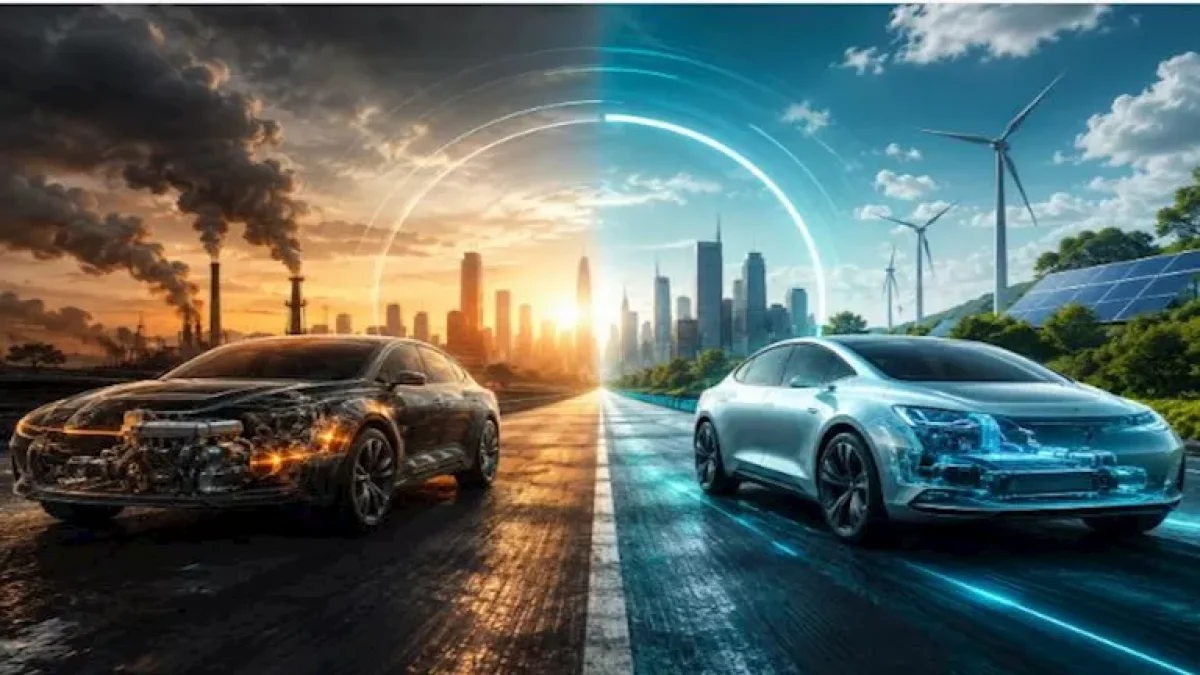
Comprehensive Comparison: REEV vs Traditional Hybrid – Which One Saves More?
The global automotive industry is undergoing a rapid shift toward electric and hybrid powertrains, gradually moving away from conventional internal combustion engines, driven by stricter emission regulations, rising fuel prices, and continuous advancements in battery technology. This transformation is no longer limited to European or Chinese markets but has extended to emerging markets, including Egypt, which has recently seen the introduction of models featuring modern technologies like DM-i and REEV alongside traditional hybrid vehicles.
REEVs: Electric Driving with a Gasoline Range Extender
Vehicles equipped with REEV (Range Extended Electric Vehicle) technology are attracting buyers seeking the benefits of an electric car without range anxiety or relying on a dense charging network. This system relies entirely on an electric motor to drive the wheels, while a gasoline engine serves solely as a generator to recharge the battery when its charge drops, without being mechanically connected to the drivetrain in most designs. The technology provides a quiet, smooth electric driving experience while enabling long-distance travel without frequent charging stops, which has driven its widespread adoption in the Chinese market in recent years.
Self-Charging Hybrid Vehicles
Traditional hybrid vehicles (HEV) combine a gasoline engine with an electric motor, alternating between the two or using both simultaneously depending on driving conditions to reduce fuel consumption and improve efficiency. These cars do not require external charging, as their batteries are recharged automatically through regenerative braking and the gasoline engine during driving, making their use similar to conventional cars without the need for charging infrastructure. Hybrids also offer good low-end torque during acceleration thanks to the electric motor, along with reduced noise and lower fuel consumption, particularly in city driving and heavy traffic.
Which Is More Cost-Effective?
When comparing economic efficiency, total cost depends heavily on usage patterns and driving conditions. REEV vehicles offer significantly lower fuel consumption for daily city driving, as regular electric charging can cover most distances without engaging the gasoline engine, substantially reducing fuel bills. Traditional hybrids, on the other hand, remain a practical choice for those without access to charging stations, as they can operate efficiently on fuel alone while still delivering lower consumption than conventional cars. The greatest savings depend on the frequency of long-distance versus urban driving, as well as local electricity and fuel prices.
Recent Developments in the Egyptian Market
The Egyptian market is currently witnessing growing demand for hybrid and electric vehicles, driven by increased awareness of their environmental and economic benefits. Some manufacturers have recently introduced REEV models in Egypt, offering consumers more diverse options between self-charging hybrids and range-extended electric vehicles. With continued improvements in charging infrastructure and rising fuel costs, these technologies are expected to see significant growth in the region, making the comparison between them increasingly important for potential buyers.
Related News
View All News
3 Valves That Protect Your Gas-Converted Car From Leaks and Overpressure
Specialists at Gastec explained that the natural gas conversion system relies on 3 main valves. The gas solenoid prevents flow when the engine stops, the filling valve secures refueling and…

NVIDIA Launches Halos SAFE Framework to Test Autonomous Driving Safety Before Trust
NVIDIA announced on October 21, 2026, the Halos SAFE framework to evaluate autonomous driving safety by combining virtual simulation, real-world testing, and fleet data analysis. The framework aims to produce…

Rivian Acquires Third Dimension AI to Accelerate Self-Driving Development
Rivian has acquired UK-based Third Dimension AI, a startup that uses AI to turn images and video into controllable 3D environments. The technology allows engineers to simulate rare and dangerous…

Agentic AI Set to Dominate Automotive Engineering: 68% of Carmakers Target Expansion Within 3 Years
A Capgemini Research Institute report reveals that 68% of automotive companies aim to increase reliance on agentic AI for non-core engineering activities to 68% within two to three years, up…

68% of Carmakers Adopt Agentic AI in Vehicle Development, Capgemini Report Finds
A Capgemini Research Institute report found that 68% of automotive companies are using or testing agentic AI in product development, with 33% in active use and 35% in pilot phases.…

