

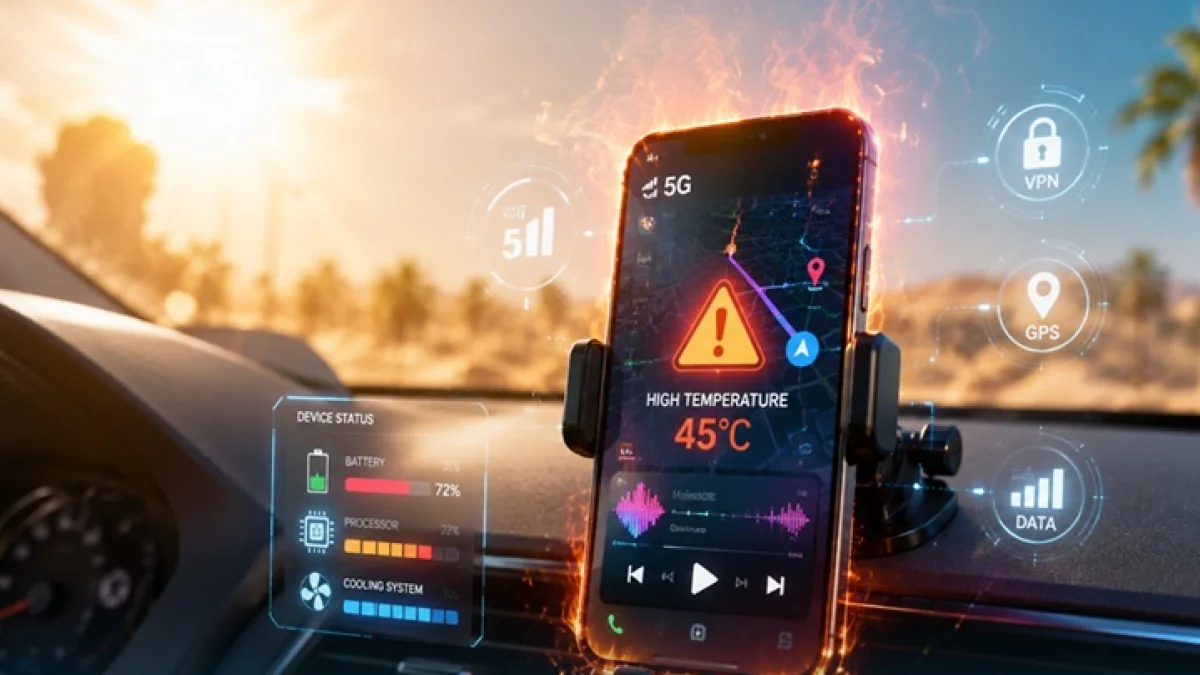
3 Phone Settings That Cause Overheating Inside Your Car — Not Just the Sun
Many drivers assume that smartphone overheating while driving is solely caused by direct sunlight and high outdoor temperatures. However, experts point out that certain settings and apps running in the background may be the real culprit behind excessive heat, even when the car's air conditioning is on.
Background Apps and Processor Load
The issue intensifies during long trips, where the phone simultaneously runs navigation apps, connects to cellular networks, and streams music — all of which increase the load on the processor and battery, affecting performance and device lifespan. One of the most significant contributors to overheating is keeping a Virtual Private Network (VPN) active at all times while on the move. As the car transitions between cell towers, the phone must constantly re-establish encrypted connections, consuming more energy and raising processor temperature. Experts recommend turning off the VPN when not needed, or using a Split Tunneling feature to exclude essential apps like maps from VPN traffic.
5G Networks and Their Thermal Impact
5G networks can also contribute to phone overheating inside the car. The device continuously searches for the strongest signal while moving, switching between 5G and 4G depending on coverage availability. This process consumes significantly more power. Since navigation and music streaming apps rarely require the maximum speeds offered by 5G, switching to 4G while driving can help reduce heat buildup and extend battery life.
Location Services Running in the Background
The reasons don't stop there. Many apps constantly use location services in the background — including weather, shopping, fitness, and transportation apps — even when not actively in use. This persistent activity puts extra strain on the processor. Therefore, it is advisable to review app permissions and grant location access only when the app is in active use.
Experts emphasize that keeping the phone away from direct sunlight, placing it in a well-ventilated area inside the car, and minimizing the number of active apps while driving can significantly reduce overheating and improve device performance, especially during intense heat waves.
Related News
View All News
3 Valves That Protect Your Gas-Converted Car From Leaks and Overpressure
Specialists at Gastec explained that the natural gas conversion system relies on 3 main valves. The gas solenoid prevents flow when the engine stops, the filling valve secures refueling and…

NVIDIA Launches Halos SAFE Framework to Test Autonomous Driving Safety Before Trust
NVIDIA announced on October 21, 2026, the Halos SAFE framework to evaluate autonomous driving safety by combining virtual simulation, real-world testing, and fleet data analysis. The framework aims to produce…

Rivian Acquires Third Dimension AI to Accelerate Self-Driving Development
Rivian has acquired UK-based Third Dimension AI, a startup that uses AI to turn images and video into controllable 3D environments. The technology allows engineers to simulate rare and dangerous…

Agentic AI Set to Dominate Automotive Engineering: 68% of Carmakers Target Expansion Within 3 Years
A Capgemini Research Institute report reveals that 68% of automotive companies aim to increase reliance on agentic AI for non-core engineering activities to 68% within two to three years, up…

68% of Carmakers Adopt Agentic AI in Vehicle Development, Capgemini Report Finds
A Capgemini Research Institute report found that 68% of automotive companies are using or testing agentic AI in product development, with 33% in active use and 35% in pilot phases.…

