

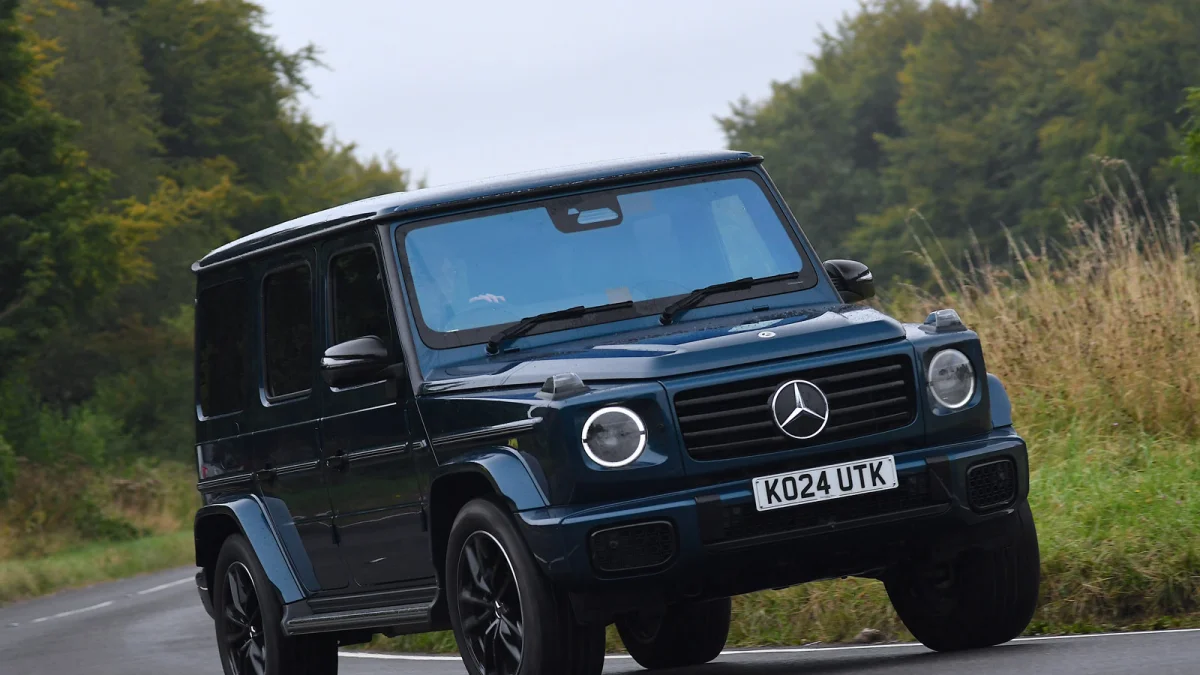
Mercedes G-Class Could Learn to Swim: Patent Reveals Floating System for Electric Version
A new patent reveals a buoyancy system for the Mercedes G-Class Electric that allows it to stay on the water surface and move across it. The system uses inflatable or foam units inside wheel cavities while keeping wheels steerable to act as rudders. The current G 580 with EQ Technology wades up to 850mm with 587hp and 1164 Nm of torque. The idea remains under engineering protection and does not guarantee production.
The Mercedes G-Class Electric could soon float on water. A new patent reveals a buoyancy system that allows the Mercedes G-Class to stay on the water surface and move across it, going far beyond its current 850mm wading depth. The idea remains under engineering protection. Yet it opens a completely new chapter.
Smart buoyancy units inside wheel cavities
The proposed system relies on removable units made from inflatable materials or foam. These units are installed inside the wheel cavities to provide the necessary buoyancy force. Each unit's size can be controlled separately. That is critical for handling uneven load distribution or unpredictable water movement. Storage is near the spare wheel area, and the tire air compressor inflates them when needed. Simple engineering intelligence.
But buoyancy alone doesn't create movement. The wheels would remain steerable while the vehicle sits on water, acting like a rudder to help change direction. This idea suits the G 580 with EQ Technology in particular. That uses four electric motors controlled independently. Independent control allows each wheel's rotation speed to change, or even spin in opposite directions. The result is precise maneuverability on water to reach dry land again.
Current G-Class Electric capabilities
The current G 580 with EQ Technology isn't an amphibious vehicle. Yet it packs serious off-road capability. It can wade through water up to approximately 850mm deep, enough to cross most water obstacles that Mercedes drivers face in normal conditions. Total output reaches 587 horsepower, with torque hitting 1164 Nm under European specs. Numbers that place it high among electric SUVs.
The vehicle also gets the G-TURN function. This feature allows the vehicle to rotate around itself on unpaved surfaces by running wheels on opposite sides in opposite directions. This technology already demonstrates the flexibility offered by independent control of four motors. That same flexibility could make the proposed buoyancy system viable. Will we actually see a swimming G-Class? The patent doesn't guarantee production. But it reveals a vision that goes far beyond current wading capabilities.
Frequently Asked Questions
3 questions answered
Related News
View All News
3 Valves That Protect Your Gas-Converted Car From Leaks and Overpressure
Specialists at Gastec explained that the natural gas conversion system relies on 3 main valves. The gas solenoid prevents flow when the engine stops, the filling valve secures refueling and…

NVIDIA Launches Halos SAFE Framework to Test Autonomous Driving Safety Before Trust
NVIDIA announced on October 21, 2026, the Halos SAFE framework to evaluate autonomous driving safety by combining virtual simulation, real-world testing, and fleet data analysis. The framework aims to produce…

Rivian Acquires Third Dimension AI to Accelerate Self-Driving Development
Rivian has acquired UK-based Third Dimension AI, a startup that uses AI to turn images and video into controllable 3D environments. The technology allows engineers to simulate rare and dangerous…

Agentic AI Set to Dominate Automotive Engineering: 68% of Carmakers Target Expansion Within 3 Years
A Capgemini Research Institute report reveals that 68% of automotive companies aim to increase reliance on agentic AI for non-core engineering activities to 68% within two to three years, up…

68% of Carmakers Adopt Agentic AI in Vehicle Development, Capgemini Report Finds
A Capgemini Research Institute report found that 68% of automotive companies are using or testing agentic AI in product development, with 33% in active use and 35% in pilot phases.…

