

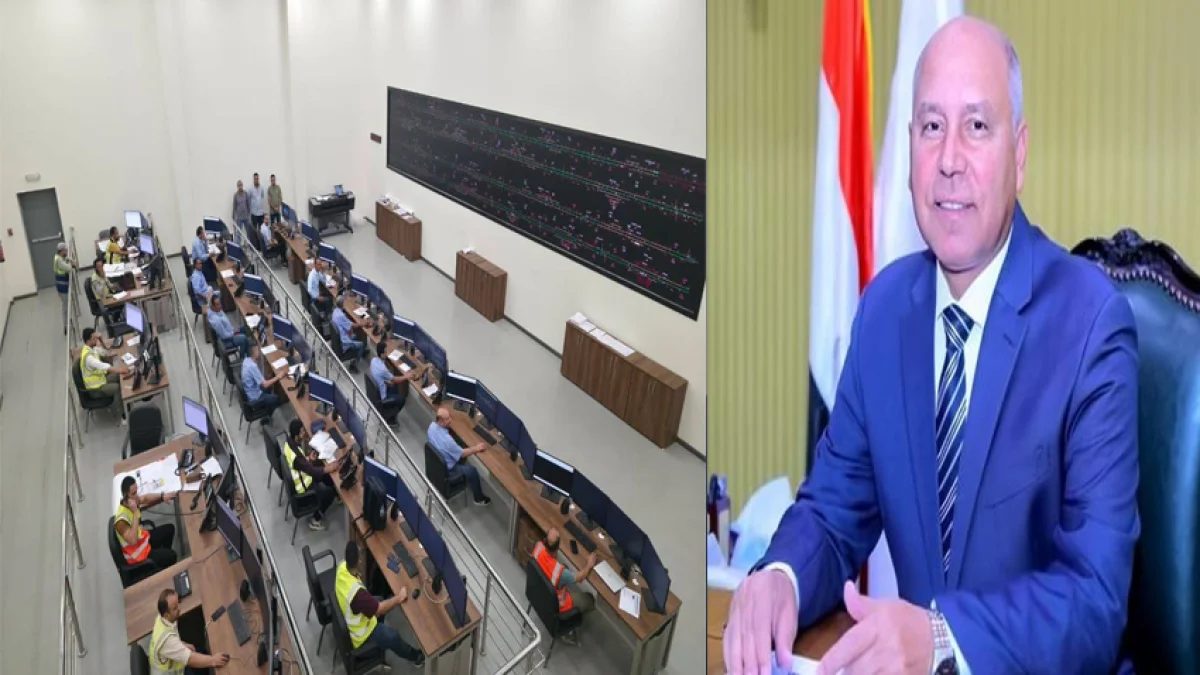
Egypt's Railways Enter Electronic Control Era: 17 Signal Towers and 59 Upgraded Crossings
Egypt's railway network is entering a new phase of modernization. The Ministry of Transport has announced the activation of the Central Traffic Control (CTC) building in Sohag governorate. That will now manage train operations along the Assiout–Naga Hammadi line, stretching 181 kilometers. This step is part of a national plan to enhance safety and efficiency through state-of-the-art electronic signaling systems.
The Final Phase of a Major Project
Minister of Transport, Lieutenant General Kamel El-Wazir, confirmed that the operation of the Sohag central control center marks the final phase of the signaling modernization project on the Assiout–Naga Hammadi route, executed by Hitachi. The project encompasses the upgrading of the entire sector from Beni Suef through Minya, Assiout, and Sohag to Naga Hammadi, covering a total length of 431 kilometers — a radical shift in how the network manages train movements in Upper Egypt.
The numbers tell the story. The new center enables centralized control over train operations along the entire line, according to the minister, which boosts safety levels, improves operational efficiency, and increases capacity while cutting travel times.
Modern Operating Systems
The line now operates entirely under the modern Electronic Interlocking System (EIS), featuring 17 main signal towers, three secondary towers, and 59 upgraded level crossings. Centralized Traffic Control (CTC) now covers the full span of the line, giving operators real-time visibility of train movements across the entire corridor.
But the work doesn't stop here. The Ministry of Transport continues its signaling modernization push on other Upper Egypt lines, with ongoing upgrades on the Cairo–Giza–Beni Suef line (125 km) and the Naga Hammadi–Luxor line (118 km). Plans are also underway to tender the development of signaling systems for the Luxor–High Dam line, extending 224 kilometers.
This strategy places Egypt's railways firmly on the path toward global standards. Modern operating systems translate into safer trains and more precise schedules — directly improving the experience of thousands of daily passengers in Upper Egypt.
Related News
View All News
3 Valves That Protect Your Gas-Converted Car From Leaks and Overpressure
Specialists at Gastec explained that the natural gas conversion system relies on 3 main valves. The gas solenoid prevents flow when the engine stops, the filling valve secures refueling and…

NVIDIA Launches Halos SAFE Framework to Test Autonomous Driving Safety Before Trust
NVIDIA announced on October 21, 2026, the Halos SAFE framework to evaluate autonomous driving safety by combining virtual simulation, real-world testing, and fleet data analysis. The framework aims to produce…

Rivian Acquires Third Dimension AI to Accelerate Self-Driving Development
Rivian has acquired UK-based Third Dimension AI, a startup that uses AI to turn images and video into controllable 3D environments. The technology allows engineers to simulate rare and dangerous…

Agentic AI Set to Dominate Automotive Engineering: 68% of Carmakers Target Expansion Within 3 Years
A Capgemini Research Institute report reveals that 68% of automotive companies aim to increase reliance on agentic AI for non-core engineering activities to 68% within two to three years, up…

68% of Carmakers Adopt Agentic AI in Vehicle Development, Capgemini Report Finds
A Capgemini Research Institute report found that 68% of automotive companies are using or testing agentic AI in product development, with 33% in active use and 35% in pilot phases.…

