

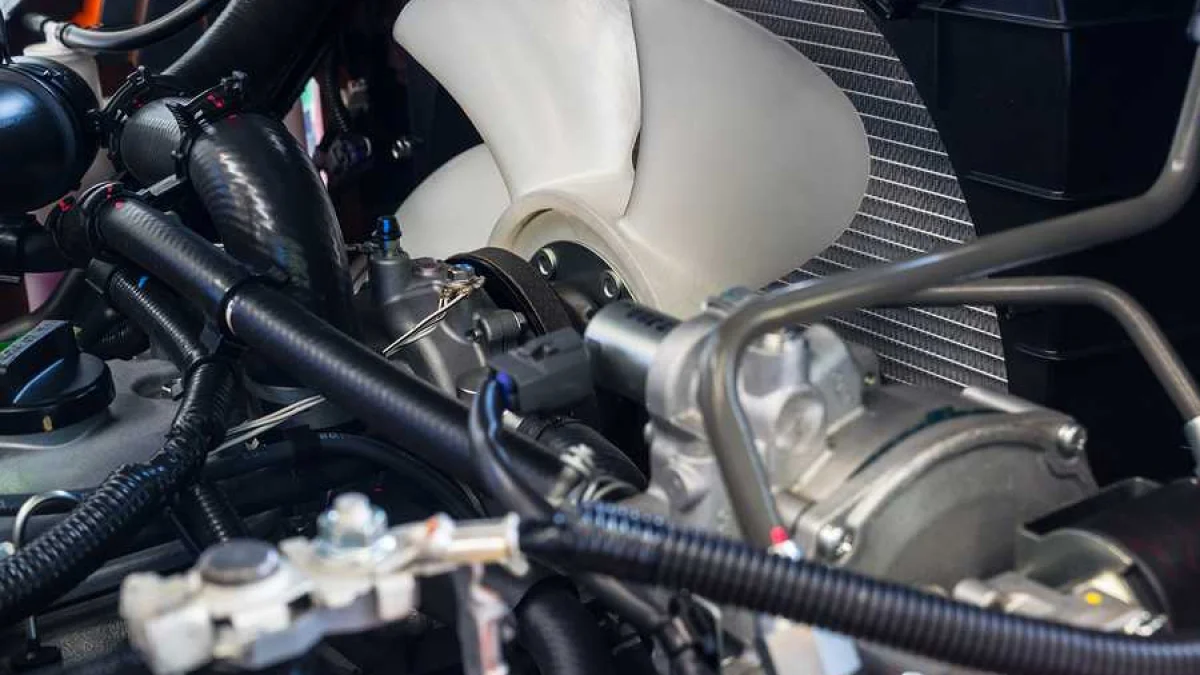
6 Signs Your Cooling Fan Is Failing — And 3 Times It's Perfectly Normal
Engine cooling fan running after ignition shutdown worries many drivers, but it's normal after long drives, in hot weather, and during traffic congestion. The ECU activates the fan for extra time to protect engine components from residual heat. Six warning signs require inspection, most notably repeated extended fan operation alongside rising temperature gauge readings and coolant loss.
Engine cooling fan running for several minutes after you turn off the ignition doesn't always mean something is broken. But it can become a warning signal when specific symptoms appear. Walid Abdo, manager of an automotive service center, confirms that engine temperature doesn't drop the moment you kill the ignition — internal components stay hot long after.
Why Does the Cooling Fan Keep Running?
The electronic control unit monitors engine temperature continuously. The number doesn't lie. If temperatures keep climbing after shutdown, the ECU allows the fan to run for an extra period to protect engine components from heat damage. Heat transfers from hot engine parts to the coolant even after the car stops. That explains why the fan sometimes stays on. This behavior is completely normal in modern vehicles, especially those with advanced electronic cooling systems found in Toyota and Hyundai models.
3 Situations Where Fan Operation Is Normal
Does the fan running after shutdown always signal a problem? No. After long highway drives, driving in temperatures exceeding 40°C, or sitting in traffic for hours — in all three scenarios, the fan running for a few minutes makes perfect sense. Duration varies between vehicles based on engine temperature, cooling system design, and driving conditions. Owners of Nissan and Kia vehicles may notice different durations because cooling system designs differ across models.
6 Signs That Confirm a Cooling Fan Fault
Inspection becomes necessary when unusual behavior appears. The fan running for extended periods and repeatedly after every trip, or activating after short drives despite normal engine temperature — these are signals you shouldn't ignore. The fan running while the engine is cold clearly indicates a faulty temperature sensor or control module. Fan operation draining the car battery is another problem demanding immediate attention. The engine temperature gauge climbing during driving multiplies the risk. Coolant levels dropping repeatedly without visible leaks may point to a deeper cooling system issue.
What Should You Do When These Symptoms Appear?
Early diagnosis saves serious money. When fan operation coincides with rising engine temperature or coolant loss, head to a specialized service center for a complete cooling system inspection. Checking the temperature sensor, thermostat, ECU, and coolant level — all essential steps. Ignoring these signs can lead to cylinder head damage or head gasket failure, repairs costing tens of thousands of pounds. Owners of older Chevrolet and Mitsubishi models should be especially alert to these symptoms because aging cooling components fail more often.
The fan isn't the enemy. It's the engine's last line of defense. But when it speaks in unfamiliar patterns, you listen immediately.
Frequently Asked Questions
3 questions answered
Related News
View All News
3 Valves That Protect Your Gas-Converted Car From Leaks and Overpressure
Specialists at Gastec explained that the natural gas conversion system relies on 3 main valves. The gas solenoid prevents flow when the engine stops, the filling valve secures refueling and…

NVIDIA Launches Halos SAFE Framework to Test Autonomous Driving Safety Before Trust
NVIDIA announced on October 21, 2026, the Halos SAFE framework to evaluate autonomous driving safety by combining virtual simulation, real-world testing, and fleet data analysis. The framework aims to produce…

Rivian Acquires Third Dimension AI to Accelerate Self-Driving Development
Rivian has acquired UK-based Third Dimension AI, a startup that uses AI to turn images and video into controllable 3D environments. The technology allows engineers to simulate rare and dangerous…

Agentic AI Set to Dominate Automotive Engineering: 68% of Carmakers Target Expansion Within 3 Years
A Capgemini Research Institute report reveals that 68% of automotive companies aim to increase reliance on agentic AI for non-core engineering activities to 68% within two to three years, up…

68% of Carmakers Adopt Agentic AI in Vehicle Development, Capgemini Report Finds
A Capgemini Research Institute report found that 68% of automotive companies are using or testing agentic AI in product development, with 33% in active use and 35% in pilot phases.…

