

What Are the Colored Lines on New Car Tires? The Secret Most Drivers Don't Know
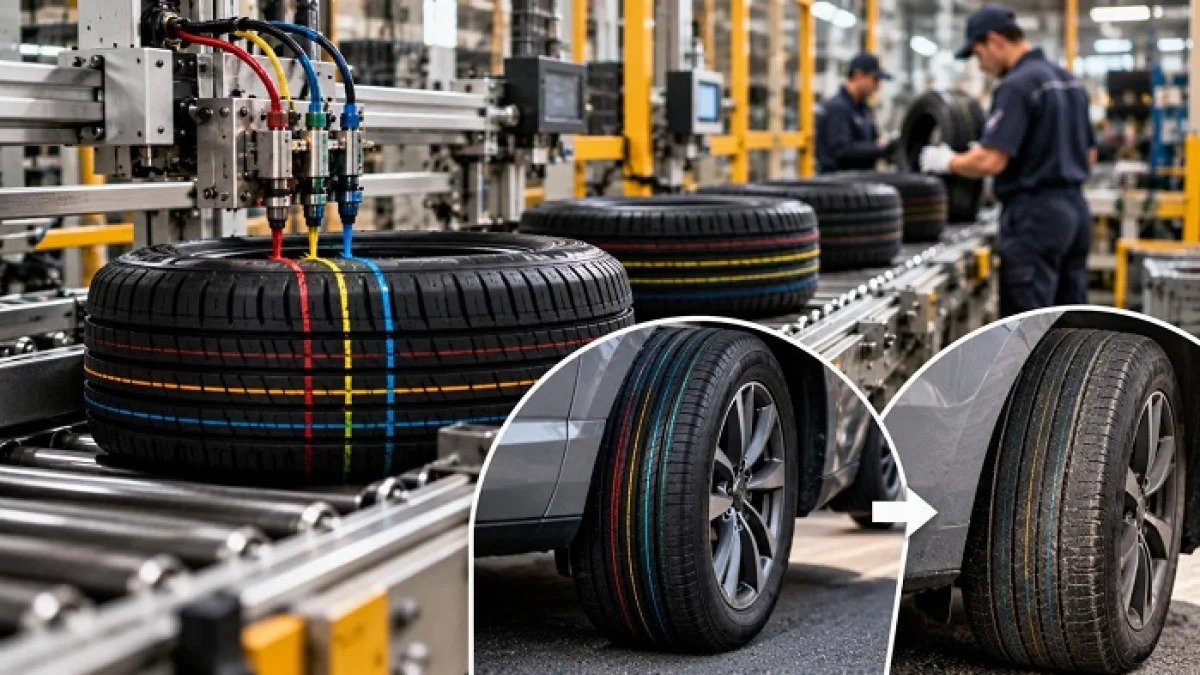
Colored lines on new car tires serve identification purposes inside tire factories and have nothing to do with tire quality or performance. No unified global standard links each color to a fixed meaning; codes vary by manufacturer. These markings are placed on rubber strips before final shaping to help identify different compounds and prevent mix-ups during production. Don't be fooled by colored lines when buying—focus on the approved specifications on the tire sidewall.
The colored lines on new car tires—whether red, yellow, blue, or green—aren't decorative, nor do they indicate higher quality or superior performance. They are identification tools used inside tire factories. These lines appear on the rubber surface and often spark curiosity among drivers who assume they signal speed ratings or road grip. The truth is purely organizational.
Why Do Tire Makers Put Colored Lines on Tires?
Tire plants produce massive daily volumes of products that vary in size, design. Rubber compound, requiring clear means of differentiation during manufacturing, assembly, and storage. Manufacturers use colored lines or alphanumeric codes on the rubber surface to easily identify components assigned to each tire type and prevent mix-ups as products move along production lines. These markings help workers and automated systems inside factories identify products and match them to production requirements without relying on the tire's external appearance alone.
Does Each Color Have a Specific Meaning?
There is no unified global standard in the tire industry that assigns a fixed meaning to each color. One company might use a blue line to denote a specific rubber compound, while another uses the same color for an entirely different purpose. Some factories rely on a series of adjacent lines, where the combined color pattern represents a specific internal code. The belief that a red line means a sporty tire, yellow indicates higher quality, or green signals low rolling resistance has no basis in a unified technical standard.
Some markings are placed on rubber strips before the final tire is shaped, so they remain visible on the tread surface after manufacturing is complete. These lines don't affect tire performance or the safety level it provides, nor do they indicate high-speed capability or road grip. Their sole function is identification and differentiation inside the factory.
What Does This Mean for Egyptian Drivers?
When buying new tires in the Egyptian market, don't be misled by colored lines that may appear on some imported tires. These lines could be remnants of the manufacturing process or internal factory markers—not an indicator of higher quality or better performance. What matters is verifying the tire specifications: size, speed rating, load index, and production date. New tires in Egypt come from various brands like Michelin, Pirelli, Goodyear. Hankook, each with its own internal marking system.
Colored lines may fade after a period of use or after washing the tire several times—this is normal because they are merely surface markings. No need to worry if they disappear. No need to search for a tire with a specific colored line believing it's better. The real criterion is what's written on the tire sidewall in internationally approved numbers and symbols. Ultimately, these lines are a small secret within tire manufacturing, but they mean nothing for your car's on-road performance.
Frequently Asked Questions
3 questions answered
Related News
View All News
3 Valves That Protect Your Gas-Converted Car From Leaks and Overpressure
Specialists at Gastec explained that the natural gas conversion system relies on 3 main valves. The gas solenoid prevents flow when the engine stops, the filling valve secures refueling and…

NVIDIA Launches Halos SAFE Framework to Test Autonomous Driving Safety Before Trust
NVIDIA announced on October 21, 2026, the Halos SAFE framework to evaluate autonomous driving safety by combining virtual simulation, real-world testing, and fleet data analysis. The framework aims to produce…

Rivian Acquires Third Dimension AI to Accelerate Self-Driving Development
Rivian has acquired UK-based Third Dimension AI, a startup that uses AI to turn images and video into controllable 3D environments. The technology allows engineers to simulate rare and dangerous…

Agentic AI Set to Dominate Automotive Engineering: 68% of Carmakers Target Expansion Within 3 Years
A Capgemini Research Institute report reveals that 68% of automotive companies aim to increase reliance on agentic AI for non-core engineering activities to 68% within two to three years, up…

68% of Carmakers Adopt Agentic AI in Vehicle Development, Capgemini Report Finds
A Capgemini Research Institute report found that 68% of automotive companies are using or testing agentic AI in product development, with 33% in active use and 35% in pilot phases.…

