

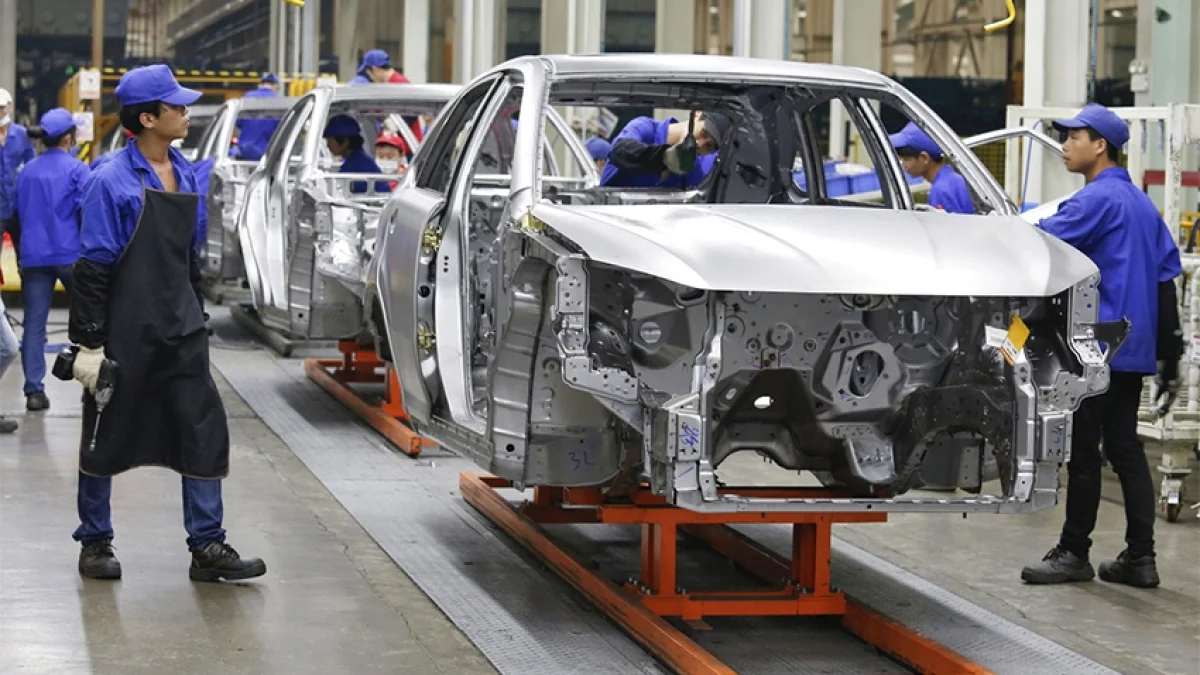
China Trains Egyptian Workforce for Smart Auto Manufacturing via Luban Workshops
The Tianjin Mechanical Engineering College in China is welcoming a new group of Egyptian students as part of the Luban Workshop automotive training program. Over 7,000 people have benefited since the program launched in November 2020. Talks are ongoing to add new specializations like smart manufacturing and industrial robotics. This cooperation supports Egypt's drive to localize smart industry and attract Chinese investment.
A new cohort of Egyptian students is heading to China under the Luban Workshop program, a training track designed to produce skilled technicians in automotive manufacturing and digital control. The Chinese president's recent visit to Cairo put this partnership in the spotlight, and it's easy to see why the workshops represent a tangible model for localizing smart industry in Egypt.
Over 7,000 People Have Benefited from Technical Training Programs
The numbers tell the story clearly. More than 3,000 individuals have benefited from the academic education offered by the workshops, while over 4,000 people have received specialized technical training, revealing just how wide this cooperation has grown since it began in November 2020. That's when the Tianjin Vocational College of Light Industry and the Tianjin College of Transport Technologies joined forces with Ain Shams University and the Advanced Technical School for Maintenance Technology in Cairo to establish the two workshops.
New Specializations Awaiting the Egyptian Market
Discussions are underway between the two sides to expand the curriculum, according to Wang Bao Long, dean of the Mechanical Engineering College at the Chinese institute. Smart manufacturing and industrial robotics top the list of proposed additions, fields that are seeing surging demand as global equipment manufacturers accelerate their digital transformation strategies.
The Egyptian students heading to the Tianjin Vocational College of Light Industry in northern China follow a complete educational pathway. The track stretches from intermediate and higher vocational education all the way to university-level programs, creating a continuous system for developing professional skills among Egyptian youth and linking them directly to the needs of local and international companies.
China's focus on Egyptian talent comes at a moment when Egypt is pushing hard to attract foreign investments in the automotive sector and its supporting industries. The partnership with the Luban Workshops is far more than a simple training initiative — it's a genuine bridge for transferring Chinese expertise in new energy and digital control technologies into the Egyptian market.
Frequently Asked Questions
2 questions answered
Related News
View All News
3 Valves That Protect Your Gas-Converted Car From Leaks and Overpressure
Specialists at Gastec explained that the natural gas conversion system relies on 3 main valves. The gas solenoid prevents flow when the engine stops, the filling valve secures refueling and…

NVIDIA Launches Halos SAFE Framework to Test Autonomous Driving Safety Before Trust
NVIDIA announced on October 21, 2026, the Halos SAFE framework to evaluate autonomous driving safety by combining virtual simulation, real-world testing, and fleet data analysis. The framework aims to produce…

Rivian Acquires Third Dimension AI to Accelerate Self-Driving Development
Rivian has acquired UK-based Third Dimension AI, a startup that uses AI to turn images and video into controllable 3D environments. The technology allows engineers to simulate rare and dangerous…

Agentic AI Set to Dominate Automotive Engineering: 68% of Carmakers Target Expansion Within 3 Years
A Capgemini Research Institute report reveals that 68% of automotive companies aim to increase reliance on agentic AI for non-core engineering activities to 68% within two to three years, up…

68% of Carmakers Adopt Agentic AI in Vehicle Development, Capgemini Report Finds
A Capgemini Research Institute report found that 68% of automotive companies are using or testing agentic AI in product development, with 33% in active use and 35% in pilot phases.…

