

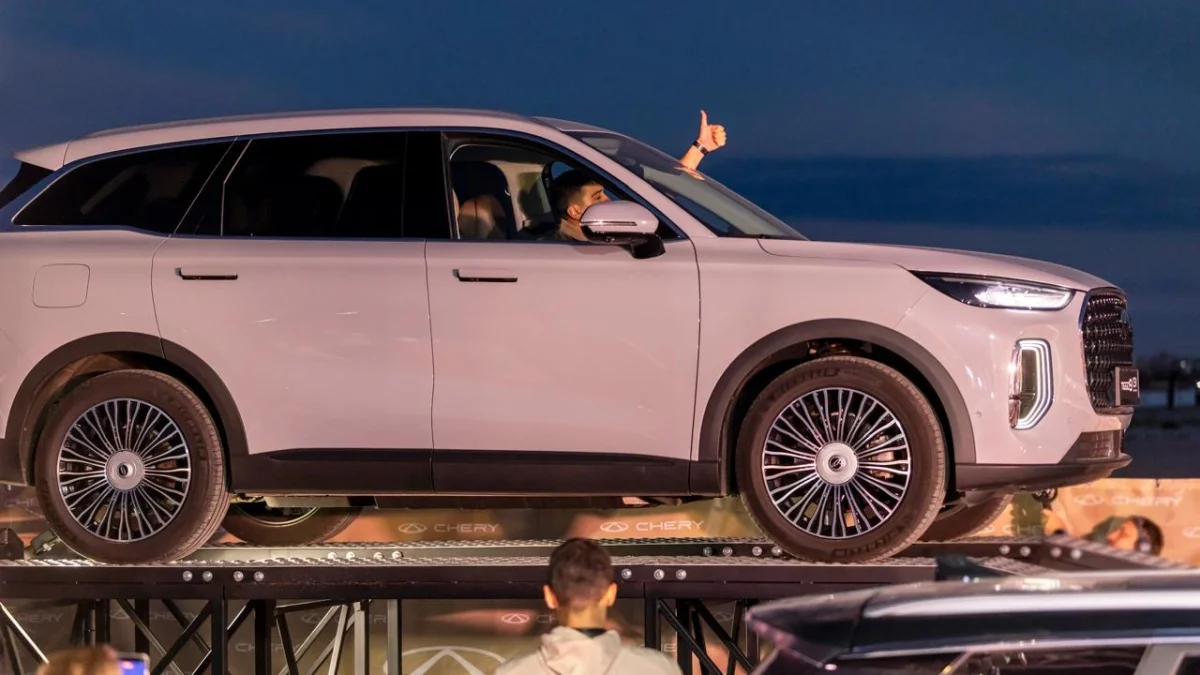
Chery Tiggo 9 CSH Survives Brutal Safety Tests: Saltwater Immersion and Underbody Impacts
Chery conducted extreme safety tests on the Tiggo 9 CSH, including a 24-hour saltwater immersion of its high-voltage battery and an underbody scraping test against a solid obstacle. Results showed no corrosion, swelling, or leakage, with a pressure leak rate of 8.067 Pa/min and insulation resistance exceeding 500 MΩ. These tests aim to boost consumer confidence in EV safety.
Chery has announced the results of extreme safety tests for its Tiggo 9 CSH, subjecting its high-voltage battery to 24 hours of saltwater immersion. The 34.46 kWh battery emerged without corrosion, swelling, or leaks. Over 150 journalists from 16 European countries witnessed the tests on the Black Sea coast. This isn't just a marketing claim — it's a hard proof of high-voltage resilience under punishing conditions.
Details of the Saltwater Immersion Test
The battery was fully submerged in a 3.5% sodium chloride (NaCl) solution for 24 hours. After removal, engineers from Chery and Germany's FEV inspected the housing, connectors, and pressure relief valve. No water ingress was found in high or low-voltage connectors. Measured leakage rate was 8.067 Pa/min, while insulation resistance exceeded 500 MΩ. What does this mean? The battery maintained electrical isolation even after a full day underwater.
Underbody Scraping Test: Direct Impact with a Solid Obstacle
After reinstalling the battery, the Tiggo 9 CSH moved to the second test. It drove at 14–15 km/h over a 250 mm high curb. This wasn't a typical speed bump. The impact was intentional, hitting a solid obstacle. The goal: measure how well the underbody and battery withstand damage. Such tests mimic real-world scenarios drivers face on rough roads or industrial ramps.
Why These Tests Matter for EV Buyers
As interest in electric and hybrid cars grows in the Egyptian market, battery safety becomes a central question. The Tiggo 9 CSH battery underwent tests beyond conventional standards. Saltwater immersion checks corrosion resistance. Underbody impacts test structural integrity. The overall result gives buyers more confidence in the vehicle's ability to handle Egypt's diverse road conditions. Is this enough to reassure the market? The numbers say yes.
What's Next? Implications for the Egyptian Market
Chery hasn't announced when the Tiggo 9 CSH will arrive in Egypt or its expected pricing. But these tests set a new benchmark for competition in the EV segment. Rivals like the BYD Song Plus and Tesla Model Y already offer advanced battery tech. The question: will other automakers follow suit with similar safety tests? Competition for trust is now part of the game. Batteries are no longer just a spec number — they're a safety story told with evidence.
Frequently Asked Questions
3 questions answered
Related News
View All News
3 Valves That Protect Your Gas-Converted Car From Leaks and Overpressure
Specialists at Gastec explained that the natural gas conversion system relies on 3 main valves. The gas solenoid prevents flow when the engine stops, the filling valve secures refueling and…

NVIDIA Launches Halos SAFE Framework to Test Autonomous Driving Safety Before Trust
NVIDIA announced on October 21, 2026, the Halos SAFE framework to evaluate autonomous driving safety by combining virtual simulation, real-world testing, and fleet data analysis. The framework aims to produce…

Rivian Acquires Third Dimension AI to Accelerate Self-Driving Development
Rivian has acquired UK-based Third Dimension AI, a startup that uses AI to turn images and video into controllable 3D environments. The technology allows engineers to simulate rare and dangerous…

Agentic AI Set to Dominate Automotive Engineering: 68% of Carmakers Target Expansion Within 3 Years
A Capgemini Research Institute report reveals that 68% of automotive companies aim to increase reliance on agentic AI for non-core engineering activities to 68% within two to three years, up…

68% of Carmakers Adopt Agentic AI in Vehicle Development, Capgemini Report Finds
A Capgemini Research Institute report found that 68% of automotive companies are using or testing agentic AI in product development, with 33% in active use and 35% in pilot phases.…

