

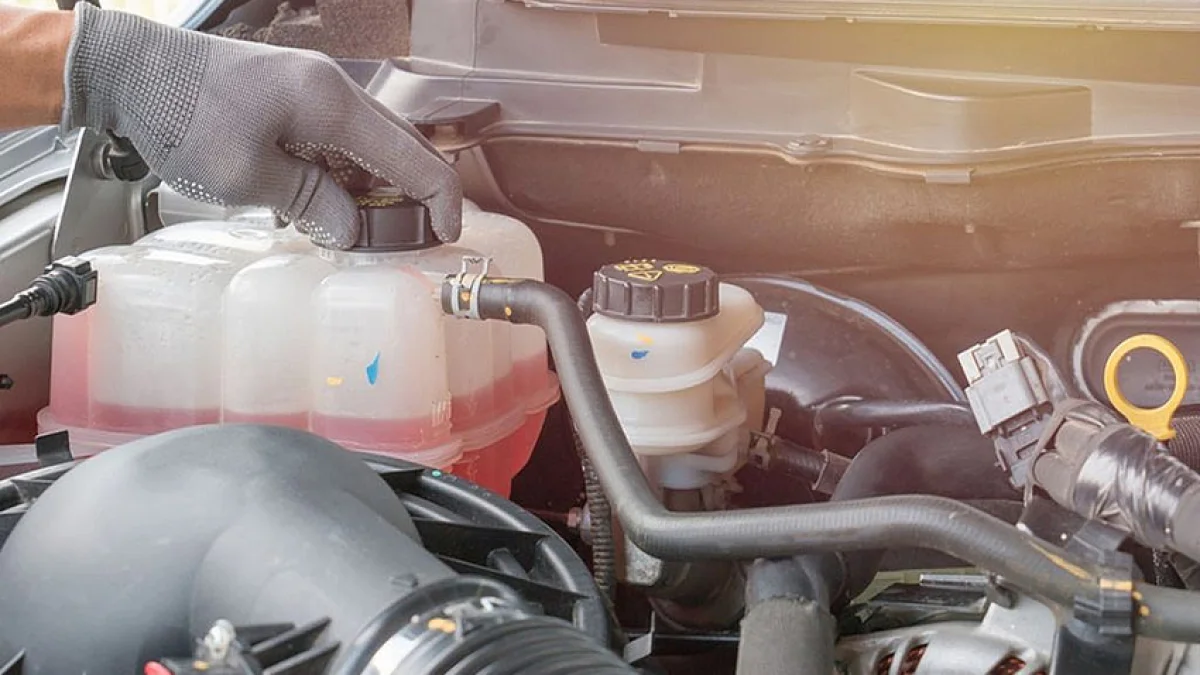
Maintenance Expert Reveals 7 Hidden Causes of Coolant Accumulation in the Reservoir Tank
The issue of coolant remaining in the reservoir tank without returning to the radiator is a common problem faced by many car owners. In this context, Waleed Abdo, manager of an automotive maintenance center, revealed seven hidden causes that may lead to this problem, ranging from simple faults that can be easily resolved to more complex issues requiring specialized technical intervention.
Key Technical Causes of Coolant Accumulation
Abdo explained that the most common cause is a faulty radiator cap, which acts as a dual valve allowing coolant to flow to the reservoir when pressure rises, then return it to the radiator when the engine cools. Any defect in the suction valve can cause water to accumulate in the reservoir without returning to its normal place. He also pointed out that a blocked or kinked hose connecting the radiator and coolant reservoir can prevent fluid movement back and forth, and that air pockets in the cooling system after maintenance can disrupt system pressure and affect fluid flow.
Leaks and Additional Malfunctions Affecting the System
The expert confirmed that a leak in the cooling system, whether in the radiator or hoses, allows air to enter the system instead of drawing water from the reservoir during the cooling process, leading to continued reservoir fullness. Among other causes, Abdo mentioned a blown head gasket, where combustion pressure leaks into the cooling passages, forcing water strongly toward the reservoir. This condition is usually accompanied by persistent air bubbles, low coolant levels, engine overheating, or white smoke from the exhaust.
Blockages and Mechanical Failures
Abdo noted that partial blockage inside the radiator due to sediment buildup can increase internal pressure and push additional coolant into the reservoir. There is also the possibility of a malfunction in one of the cooling system components, such as the thermostat, cooling fan, or water pump, which may cause the coolant to boil and expand more than normal. He emphasized that diagnosing the problem begins by checking the coolant level in the radiator when the engine is completely cold, ensuring the hose connecting to the reservoir is intact and free from blockages or cracks, and trying to replace the radiator cap with an original and approved one.
Diagnosis and Maintenance Tips
Abdo concluded by stressing that if persistent air bubbles or abnormal engine overheating are observed, the cylinder head and gasket must be inspected immediately, noting that most cases result from a faulty radiator cap or a blocked reservoir hose. Experts recommend performing regular maintenance on the car's cooling system, paying attention to radiator cleanliness, and regularly inspecting hoses and caps to ensure the system operates efficiently and to avoid sudden breakdowns that could lead to engine overheating and damage.
Related News
View All News
3 Valves That Protect Your Gas-Converted Car From Leaks and Overpressure
Specialists at Gastec explained that the natural gas conversion system relies on 3 main valves. The gas solenoid prevents flow when the engine stops, the filling valve secures refueling and…

NVIDIA Launches Halos SAFE Framework to Test Autonomous Driving Safety Before Trust
NVIDIA announced on October 21, 2026, the Halos SAFE framework to evaluate autonomous driving safety by combining virtual simulation, real-world testing, and fleet data analysis. The framework aims to produce…

Rivian Acquires Third Dimension AI to Accelerate Self-Driving Development
Rivian has acquired UK-based Third Dimension AI, a startup that uses AI to turn images and video into controllable 3D environments. The technology allows engineers to simulate rare and dangerous…

Agentic AI Set to Dominate Automotive Engineering: 68% of Carmakers Target Expansion Within 3 Years
A Capgemini Research Institute report reveals that 68% of automotive companies aim to increase reliance on agentic AI for non-core engineering activities to 68% within two to three years, up…

68% of Carmakers Adopt Agentic AI in Vehicle Development, Capgemini Report Finds
A Capgemini Research Institute report found that 68% of automotive companies are using or testing agentic AI in product development, with 33% in active use and 35% in pilot phases.…

