

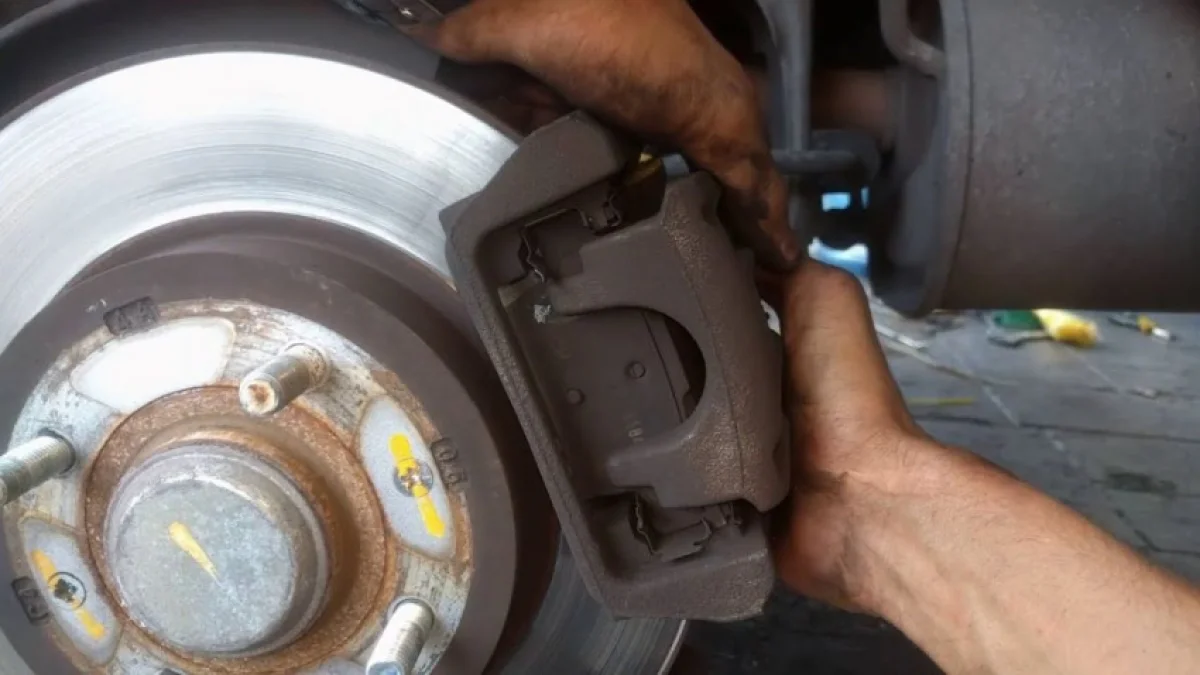
Brake Caliper Sticking: 4 Warning Signs Affecting Brake Efficiency and Driving Safety
Caliper sticking is a malfunction that may appear minor at first, but it poses a real threat to brake system efficiency and driving safety if not addressed promptly. This issue occurs when the caliper piston or its sliding pins fail to return to their normal position after releasing the brake pedal, causing continuous friction between the brake pads and the brake disc (rotor), even while the vehicle is moving without braking.
Warning Signs of a Sticking Caliper
Excessive wheel heat is at the forefront of warning signs indicating a stuck caliper. The driver may notice abnormal heat in the rim, possibly accompanied by a burning smell from the constant friction between the brake pads and the brake disc. Vehicle pull during braking is another indicator, as the car tends to veer to one side due to the affected wheel applying stronger braking force than the others.
Impact of Sticking Caliper on Vehicle Performance
Uneven brake pad wear is also a clear sign, as the pad on the side with the stuck caliper wears out much faster compared to the opposite side, affecting the brake system's efficiency and shortening the lifespan of its components. The driver may also feel heavy movement and weak acceleration due to the constant resistance imposed by the brakes on the wheel, which negatively impacts vehicle performance and fuel consumption.
Early detection of these signs limits damage and saves the driver from high repair costs. The excessive heat generated from constant friction can lead to brake disc (rotor) damage, accelerated brake pad wear, and even damage to the caliper piston itself. Caliper sticking is not just a passing mechanical failure but a defect that directly affects brake system efficiency and driving safety, requiring immediate cessation of vehicle use upon noticing symptoms, along with urgent technical inspection and maintenance to prevent worsening damage.
Related News
View All News
3 Valves That Protect Your Gas-Converted Car From Leaks and Overpressure
Specialists at Gastec explained that the natural gas conversion system relies on 3 main valves. The gas solenoid prevents flow when the engine stops, the filling valve secures refueling and…

NVIDIA Launches Halos SAFE Framework to Test Autonomous Driving Safety Before Trust
NVIDIA announced on October 21, 2026, the Halos SAFE framework to evaluate autonomous driving safety by combining virtual simulation, real-world testing, and fleet data analysis. The framework aims to produce…

Rivian Acquires Third Dimension AI to Accelerate Self-Driving Development
Rivian has acquired UK-based Third Dimension AI, a startup that uses AI to turn images and video into controllable 3D environments. The technology allows engineers to simulate rare and dangerous…

Agentic AI Set to Dominate Automotive Engineering: 68% of Carmakers Target Expansion Within 3 Years
A Capgemini Research Institute report reveals that 68% of automotive companies aim to increase reliance on agentic AI for non-core engineering activities to 68% within two to three years, up…

68% of Carmakers Adopt Agentic AI in Vehicle Development, Capgemini Report Finds
A Capgemini Research Institute report found that 68% of automotive companies are using or testing agentic AI in product development, with 33% in active use and 35% in pilot phases.…

