Robot-Drawn Carbon Fiber: How McLaren Adapted Fighter Jet Technology for Its Supercars
Supercar manufacturers are in a relentless pursuit of enhanced performance, but McLaren has recognized that the path to faster lap times and superior dynamics does not always begin with the engine. The British automotive pioneer has strategically adopted an advanced manufacturing technique directly inspired by modern fighter jet production. This bold engineering initiative aims to produce carbon fiber components that are significantly lighter and exceptionally stiffer, while simultaneously minimizing raw material waste during the complex manufacturing process. This represents a fundamental shift in automotive philosophy, focusing on optimizing the vehicle's core structure to maximize the performance benefits of every single gram saved.
Understanding McLaren ART Technology
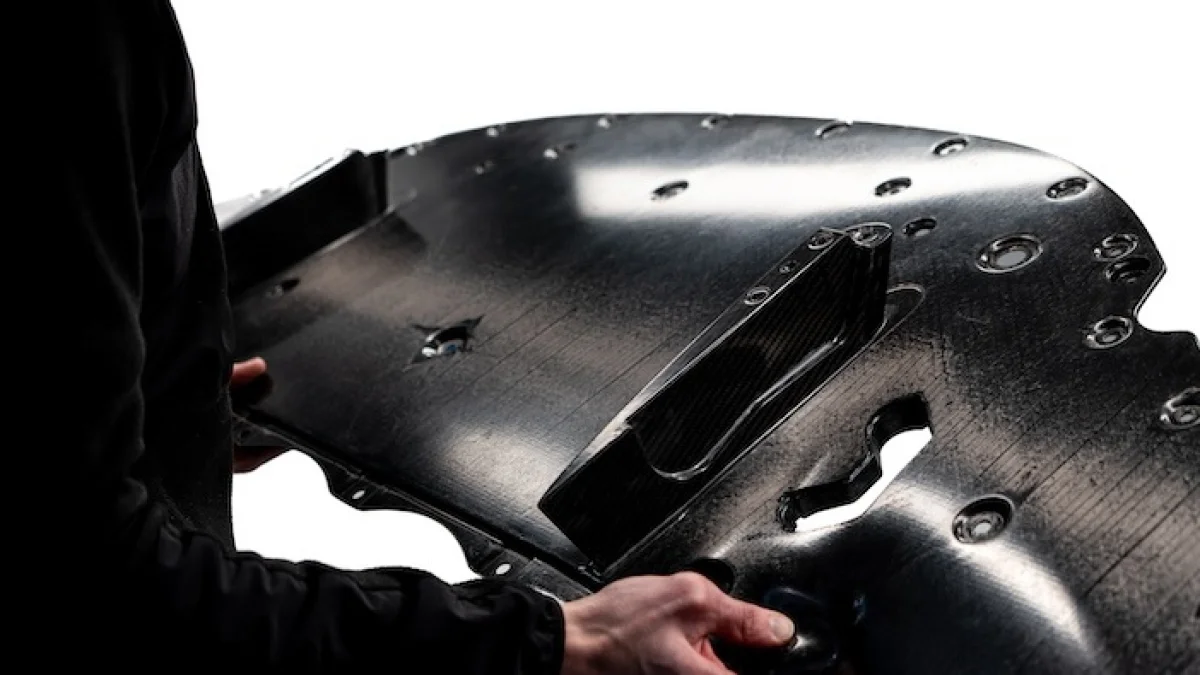
This groundbreaking methodology is known as McLaren ART, an acronym for Automated Rapid Tape. The technology relies on a sophisticated robotic system to deposit highly precise strips of carbon fiber directly onto specialized molds. This serves as a direct replacement for the traditional, labor-intensive method of manually cutting and laying large sheets of fiber, a process prone to human error and material overlap. The term ART in this context does not refer to aesthetic design, although the resulting pattern resembles a highly precise engineering blueprint. Instead, the advanced computer system calculates the exact orientation and placement of each strip based on a comprehensive analysis of the mechanical loads the component will endure. This intelligent approach ensures that material is utilized exclusively in high-stress zones, while being entirely omitted from low-stress areas, achieving a perfect equilibrium between minimal weight and maximum structural integrity.
From Aircraft Wings to Supercar Chassis
The historical roots of this technology lie deeply within the aerospace industry, where similar automated fiber placement methods are utilized to construct critical sections of modern commercial aircraft fuselages, wings, and sensitive components of military fighter jets. Aircraft inherently require structures that successfully combine three challenging engineering elements: ultra-low weight, exceptional stiffness, and the capacity to withstand repeated operational stresses and vibrations over extended periods. These are the exact same stringent requirements sought by supercar manufacturers, particularly when designing dynamic and structural parts subjected to immense forces at high speeds and during aggressive cornering. McLaren did not simply transplant a ready-made aircraft part into a road car; rather, they adopted an advanced manufacturing process born in aviation and meticulously re-engineered it to accommodate the specific production cadences and regulatory demands of road-legal supercars.
A Paradigm Shift from Traditional Carbon Fiber Manufacturing
The conventional method for manufacturing carbon fiber parts relies on pre-impregnated resin fabrics, technically known as Prepreg. These materials are cut into predetermined shapes and manually layered inside molds. This manual process demands meticulous calculation of each layer's orientation, as carbon fiber exhibits immense tensile strength strictly along the direction of the threads, with its mechanical properties degrading significantly based on placement angles and distribution. In stark contrast, ART technology utilizes continuous, thin spools of carbon fiber tape. The automated system deploys these strips with computer-guided precision, ensuring perfect alignment with actual force vectors. This drastically reduces microscopic voids between layers and provides a uniformly dense structure, elevating both safety and performance metrics in modern high-performance vehicles.
Future Implications for the Automotive Industry
Integrating advanced aerospace technologies into automotive production lines marks a defining milestone in engineering history. By embracing the Automated Rapid Tape system, McLaren's benefits extend beyond merely improving individual vehicle specifications; it enhances supply chain efficiency and reduces the environmental footprint associated with material waste. This progressive approach sets a new industry benchmark, prompting other manufacturers to pursue smarter, more efficient structural manufacturing. Ultimately, these innovations prove that the supercar race is no longer solely about raw horsepower under the hood, but about precise engineering intelligence in every structural detail, guaranteeing a driving experience that seamlessly blends absolute thrill with advanced safety.
Related News
View All News
Key, Gauges, and Mirrors: Familiar Car Details That May Vanish from Your Next Vehicle
Modern cars are rapidly going digital, and traditional features drivers have used for decades are gradually disappearing. Analog instrument clusters are being replaced by screens, start buttons are giving way…

Batteries, Fuel Cells, or Hydrogen Combustion? 3 Technologies Racing for the Future of Cars
Three technologies are competing for the future of automobiles: battery electric vehicles, hydrogen fuel cells, and hydrogen combustion engines. Global EV sales surpassed 20 million units in 2025, roughly a…
Best Engine Oils for Your Car in Summer
As summer temperatures rise, choosing the right engine oil becomes critical to protect your car's engine. Experts recommend full synthetic multi-grade oils like 5W-30 or 10W-40. Trusted brands such as…

Over 1 Billion Connected Cars by 2035 — Can Mobile Networks Keep Up?
Omdia Research projects that connected cars using cellular networks will exceed 1.05 billion by 2035, up from 473.7 million in 2025. The study warns that 4G shutdowns expected from 2030…

Don't Turn Off Your Car's AC This Winter — Experts Explain Why
Germany's TÜV NORD inspection authority recommends running your car's air conditioning at least once a week for 10 minutes, even in cold weather. Regular operation keeps compressor oil and seals…