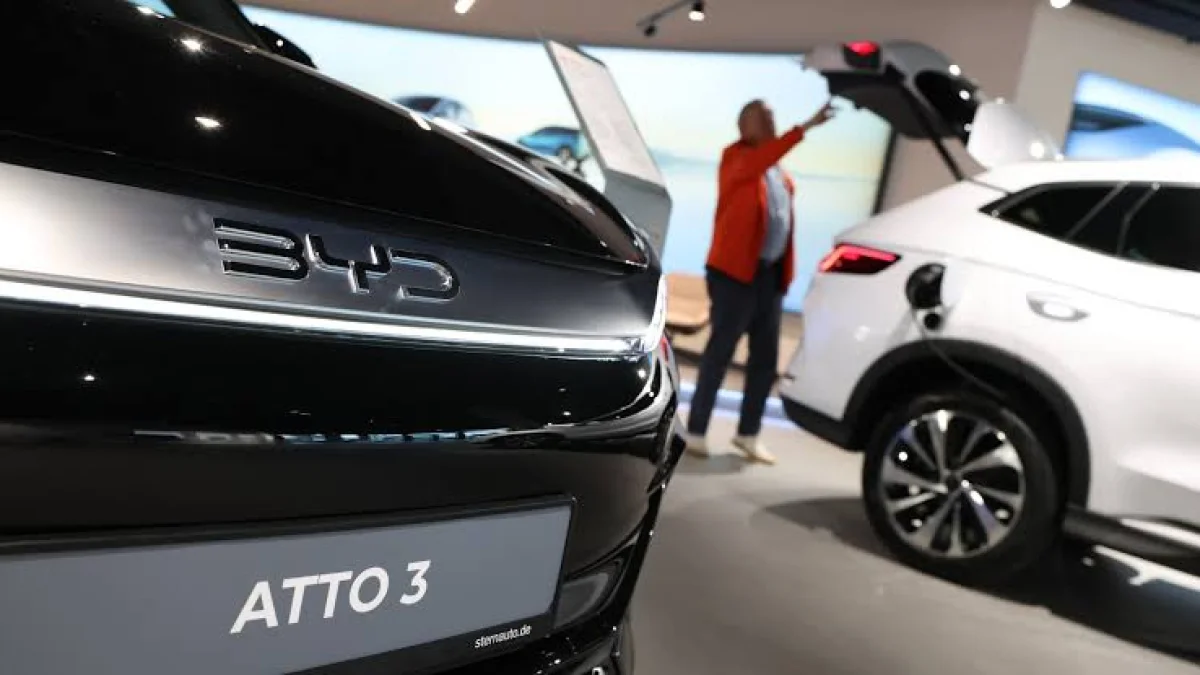
Leapmotor, Geely, and CATL Enter European Factories: Partnership or Surrender in 2026?
For years, Chinese cars were seen in Europe as cheap alternatives with inferior quality compared to German or French vehicles. However, this perception has shifted dramatically by 2026. Instead of simply exporting cars, Chinese companies are now entering Europe by acquiring stakes in European firms, forming joint manufacturing deals, and making their technology a prerequisite for the survival of longstanding brands in the competitive landscape.
A Strategic Shift in European Automotive Manufacturing
Reports from 2026 show how China has transformed from a car exporter to a key player within Europe's own automotive industry structure. Reuters noted that alliances between European and Chinese companies are no longer exceptions but have become part of the survival strategy for many European automakers amid rising global competition. This shift is not just about sales numbers; it's about deep integration into the industrial fabric.
Unprecedented Chinese Market Share in Europe
According to data from the European Automobile Manufacturers' Association (ACEA), Chinese-owned brands registered about 619,000 vehicles in the EU, UK, and EFTA during the first five months of 2026, representing roughly 10.6% of the total market. Companies like BYD, SAIC (owner of MG), Chery, Leapmotor, and Geely Group all posted notable growth during this period. Remarkably, BYD alone achieved a 136.6% year-on-year increase in registered vehicles in May 2026, surpassing Tesla, which had led the market just a year earlier. Another report indicates that China's share of the Western European car market reached 8.6% in the first quarter of 2026, nearly doubling from the previous year. This rapid growth has moved beyond being a mere "trade invasion" through exports and has evolved into a deeper strategy: acquiring equity in European companies themselves.
Major Chinese Investments in Iconic European Brands
China's Geely Group stands out as the prime example of this transformation. After fully acquiring Sweden's Volvo Cars years ago, it now owns about 9.7% of Mercedes-Benz, giving it influence within one of the world's leading luxury carmakers. Partnerships also include Renault and Geely forming Horse Powertrain, a company focused on developing hybrid engines to supply European brands with Chinese technology. Meanwhile, Leapmotor, backed by Stellantis, has begun producing cars at Stellantis' plant in Tychy, Poland, allowing it to bypass tariffs on imports from China. Similarly, CATL has announced plans to build a massive battery factory in Hungary, the largest outside China, to supply batteries locally to companies like BMW, Mercedes-Benz, and Volkswagen.
These moves raise a critical question: are these complementary partnerships, or do they represent a European surrender to Chinese industrial might? What is certain is that Chinese cars are no longer just an economical choice; they have become an integral part of Europe's mobility future. With the flow of Chinese investment and technology, we may soon witness a redefinition of the "European car" concept itself, turning it into a truly global product.
Related News
View All News
LUXEED Prepares for Global Launch on October 21 in Wuhu, China
LUXEED is preparing to hold its global launch event on October 21 in Wuhu, Anhui Province, China, under the theme 'Intelligence, Enlightened.' The event will feature the world premiere of…

Avatr CONCEPT T09 with 1000+ HP Challenges Maybach and Rolls-Royce at Paris Show
Avatr unveils the CONCEPT T09 at the 2026 Paris Motor Show, a large luxury SUV with over 1000 horsepower and massive dimensions (5285 mm length). It features a hybrid powertrain…

Morocco Produces 700,000 Cars Annually, Surpassing Italy with $16 Billion in Export Revenue
Morocco has solidified its position as an African manufacturing power, producing 700,000 vehicles annually and generating over $16 billion in automotive export revenue, outpacing Italy. Industrial activity spans 150 zones…
Opel CEO: Adam Small Car Out of Plans Until 2030 Due to EU Regulations
Opel CEO Florian Huettl has confirmed the Adam small car is not in the company's product plans until 2030 due to stringent European regulatory requirements. Speaking at the 2026 Paris…
Tesla Roadster Jumps Mid-Air with SpaceX-Inspired Rocket Technology
Tesla has revealed the next-generation Roadster in a Texas demonstration where the car jumped into the air and rotated before landing, using thrusters inspired by SpaceX rockets. The system relies…