Automatic vs CVT vs DCT: Which Transmission is Right for You?
Choosing the right transmission is no longer a minor technical detail. It's now one of the most critical decisions determining driving experience, fuel consumption, and long-term maintenance costs.
Why Your Choice of Gearbox Matters More Than Ever
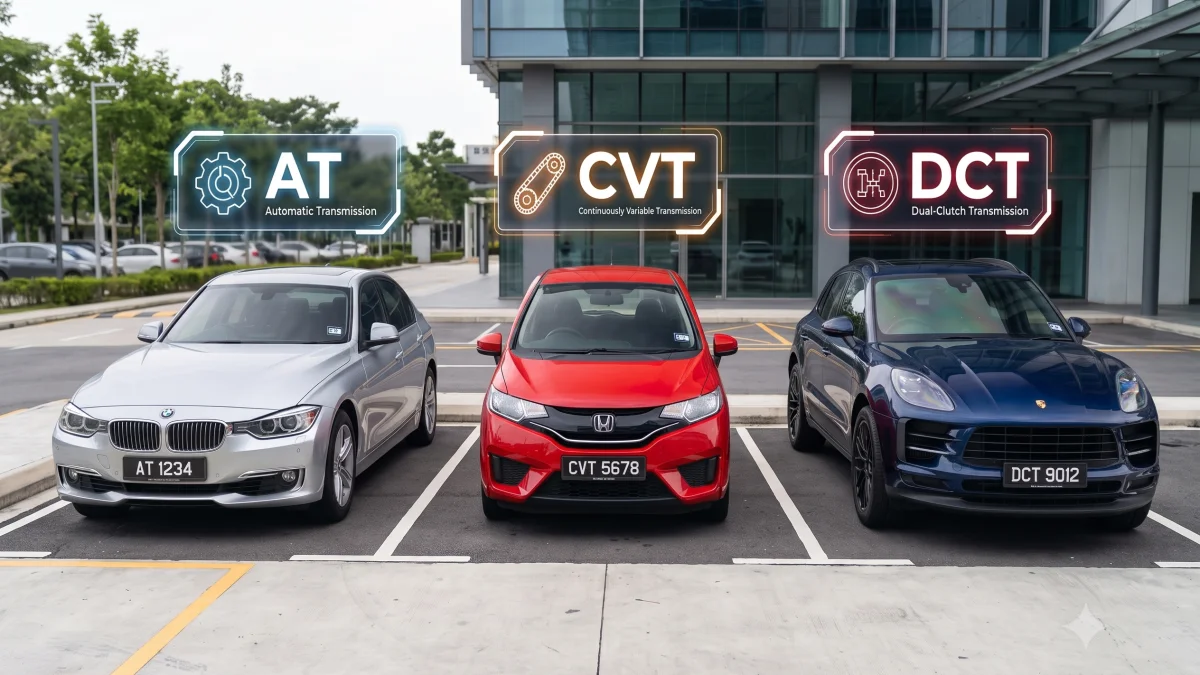
The question has shifted far beyond 'automatic or manual.' Three types dominate the modern automotive landscape: the traditional automatic (AT), the continuously variable transmission (CVT), and the dual-clutch transmission (DCT). Each offers a fundamentally different philosophy.
Buyers often wonder about the difference between an automatic, CVT, and DCT gearbox when comparing new and used cars. Others search for the best type suited for daily traffic jams and long highway stretches.
This guide offers a clear comparison. We explain how each type works, its strengths, and its weaknesses. The goal is to help you choose with confidence.
The Three Contenders for Your Next Car
Before diving into details, here are the most common automatic transmission types in modern vehicles.
The traditional automatic (AT) is built for comfort and reliability. The CVT is optimized for fuel economy and city driving. The DCT is engineered for sporty performance and rapid response.
Each has a different inner mechanism. These differences impact your feeling behind the wheel directly.
Traditional Automatic (AT): Decades of Proven Reliability
This system is the oldest and most battle-tested. Known as the Torque Converter Automatic, it has been the backbone of most automatic cars for years.
How It Actually Works
It relies on a torque converter and complex hydraulic systems. Gear changes happen fully automatically, completely without driver intervention. It achieves this by engaging different planetary gear sets.
The advantages are clear: very smooth gear shifts. Long-term reliability is a major hallmark. It handles city traffic and congestion quite well. Easy for beginners and comfortable on highways.
But nothing comes free. Fuel consumption can be slightly higher than newer technologies. Acceleration response is slower compared to DCT. Still, it remains a preferred choice thanks to its durability and simple maintenance.
CVT: A Revolution in Fuel Efficiency
This type offers a completely different approach from traditional automatics. There are no fixed gears in the conventional sense. The picture is different here.
The Unique Mechanics Inside
The system uses pulleys and a metal belt. This design allows for an almost infinite number of gear ratios. The engine always operates within its optimal RPM range. The result is noticeable fuel savings.
Smaller engines work very well with CVTs. In the city, the driver feels remarkable smoothness. There are no abrupt shift points.
Yet the CVT has drawbacks. The noise can be intrusive under hard acceleration — the engine stays at a constant high RPM. Maintenance is slightly pricier than a regular automatic. It may not satisfy those seeking a sporty driving feel.
DCT: The Speed of Sporty Performance
This is the transmission of choice for performance and speed enthusiasts. DCT changes the game entirely in the world of automatic gearboxes.
The Technology Behind the Speed
The system has two separate clutches. One handles odd-numbered gears, the other manages even-numbered gears. While one clutch is engaged, the other pre-selects the next gear. Shifts happen in milliseconds.
Acceleration response is incredibly sharp and quick. Efficiency is close to a manual gearbox, with the convenience of an automatic. Ideal for spirited driving and open roads.
But DCT isn't for everyone. At very low speeds or in stop-and-go traffic, shifts can feel a bit jerky. Maintenance costs are significantly higher than other types. Sensitivity to harsh driving habits can shorten clutch life.
Finding Your Perfect Match
The market is full of options. Each transmission type suits a different lifestyle. There is no single correct answer, only the one that fits you.
If you drive in heavy traffic daily and prioritize absolute comfort and reliability, the traditional automatic (AT) is your best bet. If your primary goal is fuel economy and city driving, the CVT is an ideal choice. If you crave sporty performance, instant throttle response, and rapid acceleration, don't hesitate to pick the DCT.
The comparison goes beyond just automatic, CVT, or DCT. It's about understanding your actual needs. Choose wisely, and you will enjoy a driving experience that satisfies you for years to come.
Related News
View All NewsReport reveals: The turbo engines most prone to failure after 80,000 km
Recent fleet data shows that several turbocharged engines in Egypt begin showing costly failures at just 80,000 kilometers, while others last much longer. The main cause isn't design alone but…

Unqualified Influencers Threaten Egypt's Economy and Corporate Reputation
Dr. Said Hamed, a media professor at Suez University, warned that content from unqualified influencers on social media can damage Egypt's national economy and the reputation of state institutions. He…

Beyond the Headlines: What Really Drives Engagement on Egyptian Auto Sites?
The report examines competition among auto sites in Egypt, noting that superiority depends on understanding local buyer needs for content combining price and running costs. Analyses show over 60% of…

Egypt's One-Billion-Pound Fund Revives Ailing Auto Factories
Egypt's Central Bank and Ministry of Industry have launched a one-billion-pound fund to restructure struggling factories and restore idle production capacity. The fund will take equity stakes, restructure debt, and…

Is Now the Right Time to Buy a New Car in Egypt? 6 Indicators That Decide
New car sales in Egypt rose 29.7% in the first seven months of 2026, reaching 116,869 vehicles, with passenger car sales up 25%. Overprice premiums have declined on several models…