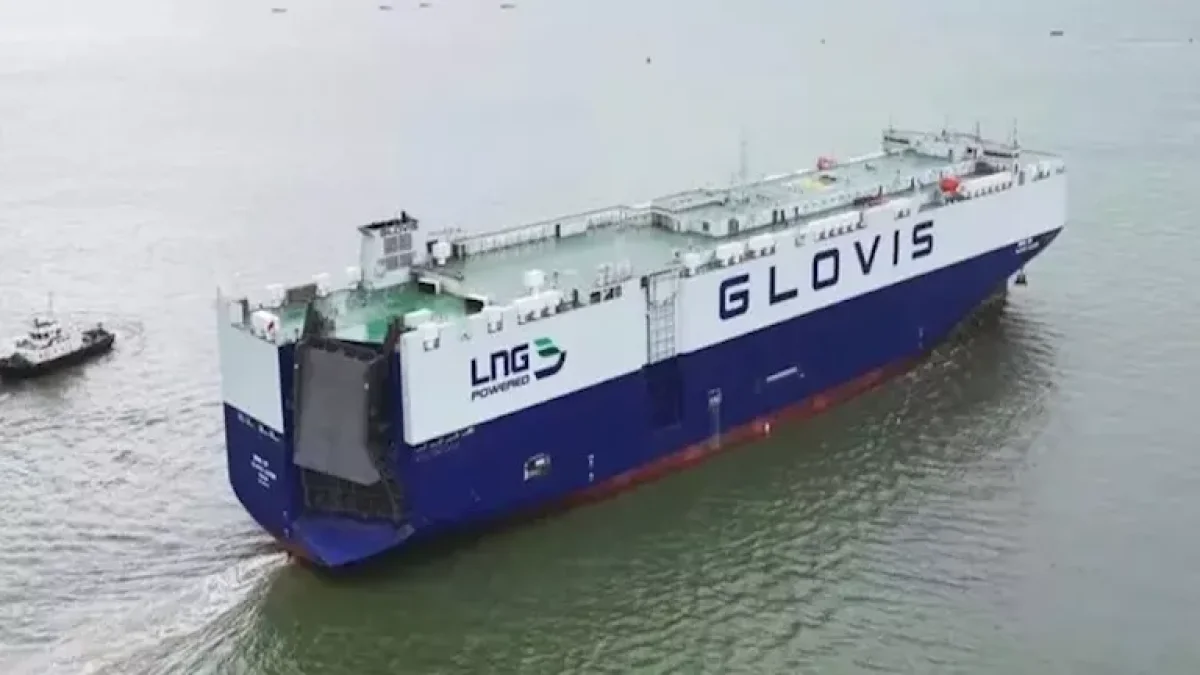
China Amazes Again: World's Largest Floating Car Park Revealed, Holding Nearly 11,000 Vehicles
China continues to strengthen its dominance in shipbuilding and maritime transport with the unveiling of the massive car carrier Glovis Leader by GSI, a subsidiary of the state-owned CSSC group. The vessel is being hailed as the world's largest floating car park, boasting a staggering capacity of approximately 10,800 vehicles in a single voyage, making it an unprecedented maritime platform for transporting all types of vehicles.
Specifications and Operational Technology
The ship features 14 dedicated decks designed to accommodate a wide variety of vehicles, including conventional cars, electric vehicles, hydrogen-powered models, and heavy trucks. The Glovis Leader measures 230 meters in length and 40 meters in width, enabling it to function as a highly efficient floating garage. Mr. Zhang Fuli, Technical Director at GSI, confirmed that the vessel employs a dual-fuel propulsion system running on liquefied natural gas and traditional marine fuel. It is also equipped with an onboard generator system that powers all operations during sea voyages, significantly enhancing overall energy efficiency.
Environmental Compliance and Emission Reduction
The advanced technologies integrated into the ship's design allow it to comply with the strict Tier III emission standards set by the International Maritime Organization. This results in a notable reduction in nitrogen oxide emissions compared to conventional ships. Furthermore, preliminary studies have been conducted to enable the vessel to be converted to run on ammonia or methanol fuel in the future, reflecting a strong commitment to sustainable maritime transport. The Glovis Leader can reach a maximum speed of 19 knots and has a maximum draft of 10.5 meters, making it ideal for long-haul international routes.
Impact on the Global Automotive Logistics Sector
South Korea's Hyundai Glovis company is scheduled to operate the new carrier. CEO Lee Kyoo-bok emphasized that this vessel transcends the role of a traditional transport ship, setting a new benchmark for sea-based vehicle logistics thanks to its immense capacity and low-emission operation system. The delivery of this ship reflects China's rapid and significant growth in building advanced, large-scale vessels, further solidifying its position as a key player in the global automotive export supply chain.
Related News
View All News
BYD Launches Electric Truck Offensive Against Volvo and Mercedes in Europe
BYD has unveiled a heavy-duty electric truck with a range of 600 kilometers and 20% to 80% charging in 20 minutes, targeting Europe's truck market. Volvo and Mercedes-Benz together controlled…

LUXEED Prepares for Global Launch on October 21 in Wuhu, China
LUXEED is preparing to hold its global launch event on October 21 in Wuhu, Anhui Province, China, under the theme 'Intelligence, Enlightened.' The event will feature the world premiere of…

Avatr CONCEPT T09 with 1000+ HP Challenges Maybach and Rolls-Royce at Paris Show
Avatr unveils the CONCEPT T09 at the 2026 Paris Motor Show, a large luxury SUV with over 1000 horsepower and massive dimensions (5285 mm length). It features a hybrid powertrain…

Morocco Produces 700,000 Cars Annually, Surpassing Italy with $16 Billion in Export Revenue
Morocco has solidified its position as an African manufacturing power, producing 700,000 vehicles annually and generating over $16 billion in automotive export revenue, outpacing Italy. Industrial activity spans 150 zones…

Opel CEO: Adam Small Car Out of Plans Until 2030 Due to EU Regulations
Opel CEO Florian Huettl has confirmed the Adam small car is not in the company's product plans until 2030 due to stringent European regulatory requirements. Speaking at the 2026 Paris…